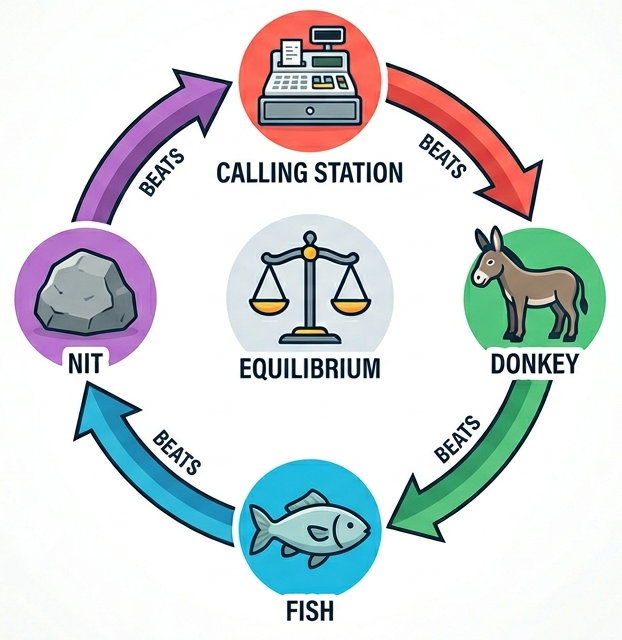
In every given scenario, there is a perfect strategy in equilibrium, which is unexploitable but does nothing to particularly exploit any other strategy. The degree the strategy deviates from equilibrium governs how much that strategy loses to equilibrium.
As humans, we cannot play an equilibrium strategy. This offers us two choices:
My strategy is to look like I'm doing the former while actually doing the latter.
The 'equilibrium' way to play 'Paper, Scissors, Rock' is to use randomization to throw exactly 33.33% of each.
But against an opponent who throws Rock 50% of the time, you can do better than equilibrium.
You can throw Paper.
And people say 'equilibrium' is a synonym for 'game theory optimal'...
Each of these four non-equilibrium archetypes deviates from equilibrium in a different way, and those differences exploit one (or more) of the others.
The Nit is the only one which deviates from equilibrium by playing too few hands. The Station, the Donkey, and the Fish all play an excess of hands, and they each do something different with those excess hands (Call, Raise, Fold).
The Nit wants to bring you to value-town, and exploits the Calling Station's tendancy to call by doing just that.
The Calling Station hates liars. They want to catch people bluffing. They exploit the Donkey, who lives for the thrill of making people fold the best hand.
The Donkey exploits the Fish by making them fold the excess hands they called with preflop.
The Fish doesn't exploit the Nit so much as it avoids being exploited by the Nit, who passes on the potential profit of fold equity against the Fish.
When your opponent is a Fish, you want to be a bit of a Donkey.
When your opponent is a Donkey, you want to be a bit of a Station, maybe even Nit-up a touch.
When your opponent is a Station, you want to be a bit of a Nit.
When your opponent is a Nit, you want to be a mix of Donkey and Fish, raising small to eat their blinds and isolate fish, immediately giving up when the Nit volunteers a chip.